Target Selection, Escalation Dynamics, and Predictive Assessment
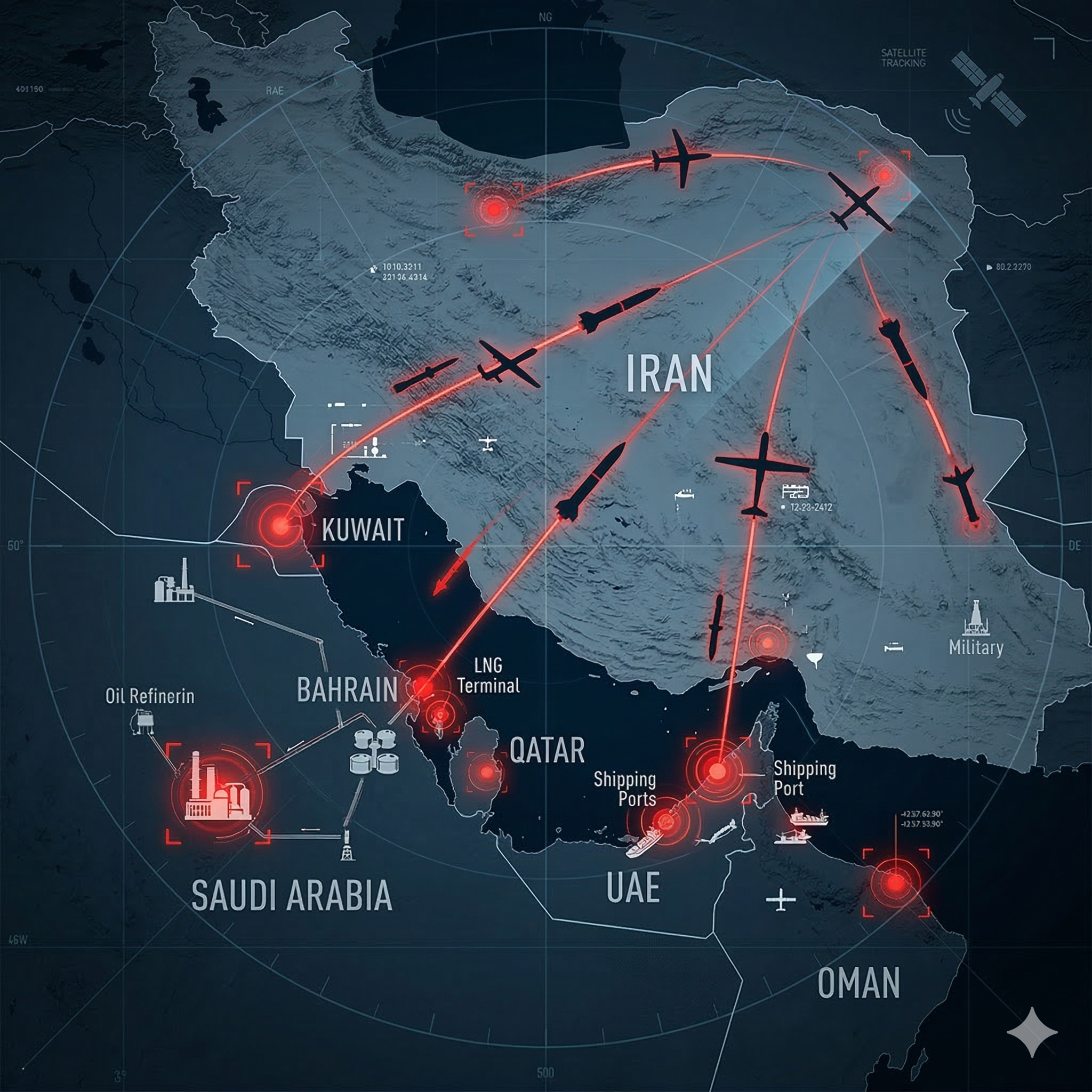
| Scope: All six GCC member states | Period: February 28 – March 14, 2026 |
| Entries: 43 documented strike events | Classification: Open-source intelligence (OSINT) |
ABSTRACT
This paper applies contemporary military-strategic analytical frameworks — including Effects-Based Operations (EBO) analysis, Robert Pape’s coercive air power theory, Schelling’s escalation ladder, and target-set analysis methodology drawn from Joint Intelligence Preparation of the Operational Environment (JIPOE) — to 43 documented Iranian strike events against Gulf Cooperation Council (GCC) member states during the February–March 2026 conflict. Analysis reveals a structured, six-phase targeting campaign organized around five principal target categories: US military installations, energy infrastructure, diplomatic facilities, civilian critical infrastructure, and maritime assets. Iran’s campaign exhibits hallmarks of a systematic coercive strategy rather than a purely retaliatory or punitive campaign. Six distinct operational patterns are identified: (1) simultaneous multi-state saturation designed to overwhelm air defense coordination; (2) deliberate escalation sequencing from military to economic to civilian targets; (3) the strategic weaponization of energy interdependence; (4) asymmetric weapon-to-target matching favoring drones for area saturation and ballistic missiles for hardened installations; (5) exploitation of GCC intra-alliance coordination gaps; and (6) a two-track signaling strategy directed simultaneously at GCC governments and the US administration. Predictive modeling suggests that Iran’s near-term behavior will increasingly concentrate on energy infrastructure as the conflict’s primary coercive lever, accompanied by sustained maritime pressure on alternative shipping corridors previously considered safe. The paper concludes with a tiered framework of security recommendations for GCC states, encompassing enhanced air domain awareness, critical infrastructure hardening, and coordinated alliance-level counter-drone doctrine.